Response:
Strategic framework
Each organization need to establish its own strategic framework in order to have significant success. In lecture, strategic framework is to provide a broader context within which the analysis techniques and tools are applied for strategy formulation which includes the external environment, pressure groups and stakeholders and internal business strategizing and planning. To explain it in a easier way, a strategic framework consists of a vision for your future, a mission that defines what you are doing, values that shape your actions, strategies that zero in your key success approaches, and goals and action plans to guide your daily, weekly and monthly actions. There are two analysis PEST and SWOT.

PEST analysis

PEST analysis to describes a framework of macroenvironmental factors and analyze the impact of the overall business environment in the early stage of strategic thinking. PEST respectively represent Political factors, Economic factors, Social factors and Technical factors. It is very important that an organization considers its environment before beginning the marketing process. In fact, environmental analysis should be continuous and feed all aspects of planning.
For Political factors, they usually include government regulations and legal issues and define both formal and informal rules under which the organizations must operate such as tax policy, environmental regulations, employment laws, political stability etc. For these factors, organizations should consider that following issues,
First, How stable is the political environment?
Second, Will government policy influence laws that regulate or tax your business?
Third, What is the government's position on marketing ethics?
Fourth, What is the government's policy on the economy?
Fifth, Does the government have a view on culture and religion?
Sixth, Is the government involved in trading agreements such as EU, NAFTA, ASEAN, or others?
Third, What is the government's position on marketing ethics?
Fourth, What is the government's policy on the economy?
Fifth, Does the government have a view on culture and religion?
Sixth, Is the government involved in trading agreements such as EU, NAFTA, ASEAN, or others?
For Economic factors, they affect the purchasing power of potential customers and the organizations' cost of capital. The examples are economic growth, interest rates, exchange rates and inflation rate etc. For these factors, organizations should consider that following issues,
First, Interest rates,
Second, The level of inflation Employment level per capita,
Third, Long-term prospects for the economy Gross Domestic Product (GDP) per capita, and so on.
First, Interest rates,
Second, The level of inflation Employment level per capita,
Third, Long-term prospects for the economy Gross Domestic Product (GDP) per capita, and so on.
For Social factors, they include the demographic and cultural aspects of the external macroenvironment. These factors affect customer needs and the size of potential markets. The examples are health consciousness, population growth rate, age distribution, career attitudes and emphasis on safety etc. For these factors, organizations should consider that following issues,
First, What is the dominant religion?
Second, What are attitudes to foreign products and services?
Third, Does language impact upon the diffusion of products onto markets?
Fourth, How much time do consumers have for leisure?
Fifth, What are the roles of men and women within society?
Sixth, How long are the population living? Are the older generations wealthy?
Seventh, Do the population have a strong/weak opinion on green issues?
Second, What are attitudes to foreign products and services?
Third, Does language impact upon the diffusion of products onto markets?
Fourth, How much time do consumers have for leisure?
Fifth, What are the roles of men and women within society?
Sixth, How long are the population living? Are the older generations wealthy?
Seventh, Do the population have a strong/weak opinion on green issues?
For Technological factors, they can lower barriers to entry, reduce minimum efficient production levels, and influence outsourcing decisions. The examples are R&D activity, Automation, Technology incentives and Rate of technological change etc. For these factors, organizations should consider that following issues,
First, Does technology allow for products and services to be made more cheaply and to a better standard of quality?
Second, Do the technologies offer consumers and businesses more innovative products and services such as Internet banking, new generation mobile telephones, etc?
Third, How is distribution changed by new technologies e.g. books via the Internet, flight tickets, auctions, etc?
Fourth, Does technology offer companies a new way to communicate with consumers e.g. banners, Customer Relationship Management, etc?
Second, Do the technologies offer consumers and businesses more innovative products and services such as Internet banking, new generation mobile telephones, etc?
Third, How is distribution changed by new technologies e.g. books via the Internet, flight tickets, auctions, etc?
Fourth, Does technology offer companies a new way to communicate with consumers e.g. banners, Customer Relationship Management, etc?
SWOT analysis
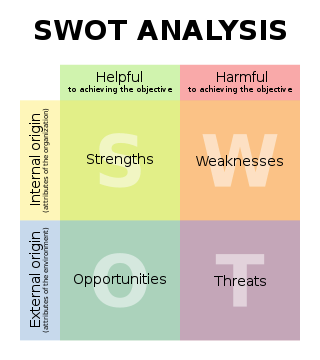
SWOT analysis is a tool for auditing an organization and its environment. It is the first stage of planning and helps marketers to focus on key issues. SWOT respectively represent Strengths, Weaknesses, Opportunities, and Threats. Strengths and weaknesses are internal factors while opportunities and threats are external factors.
For Strengths, an organization's strengths are its resources and capabilities that can be used as a basis for developing a competitive advantage. The examples include patents, strong brand names, good reputation among customers etc.
For Weaknesses, the absence of the above strengths can be viewed as weaknesses. For example, they may lack of patent protection, have a weak brand name, poor reputation among customers, high cost structure etc.
For Opportunities, the external environmental analysis may reveal new opportunities for profit and growth. The examples are arrival of new technologies, loosening of regulations, removal of international trade barriers etc.
For Threats, changes in the external environmental may also be the threats to an organization. The examples are shifts in consumer tastes away from the organization's products, emergence of substitute products, new regulations, increased trade barriers etc.
Conclusion
To conclude, strategic framework helps to analyze both internal, external, macroenvironmental and microenvironmental issue of the organization. Therefore, a right strategic framework is very important for an organization to have a clear vision for its business. It is one of the keys to lead the organizations to success.
Source / Reference:
1) Suillivan, “Systems planning in the information age,” Sloan Management Review, 1985
1) Suillivan, “Systems planning in the information age,” Sloan Management Review, 1985
2) "PEST: Political, Economic, Social, and Technology Analysis" by The Decision Group 2009
3) “Strategy and Vision Statements"
4) "A knowledge-based SWOT-analysis system as an instrument for strategic planning in small and medium sized enterprises" by G. Houben, K. Lenie, K. Vanhoof 1999
5) “Making the Most of Your Company's Knowledge: A Strategic Framework” by Georg von Krogh, Ikujiro Nonaka, Manfred Aben 2001


