2012年3月25日 星期日

W11 - Redesign Principles and Tactics (2)


Response:


In my last blog article, I have analyze the principles and tactics of first 2 types which are “restructuring and reconfiguring the process”, “changing the information flows around the process”. In this lecture, I have learnt the remaining one: Minding which is changing knowledge management around the process. I will also analyze these principles and give case studies which had applied these principles to make use of what I've learnt on the lesson.


Minding - Changing knowledge management around the process


Principle #8 - Analyze and Synthesize


It is to enhance the interactive analysis & synthesis capabilities around a process to generate value added.


This principle is mostly applied to business like agents that have to make recommendation to customers by summarizing and analyzing the information.


The common tactics of this principle are
1) Provide what-if capabilities to analyze decision choices
2) Provide slice and dice data analysis capabilities that detect patterns
3) Provide intelligent integration capabilities across multiple information sources


Principle #9 - Connect, Collect & Create


It is to capture intelligent and reusable knowledge around the process through all who touch it.


One of the examples is the creation of Knowledge Repository through collecting the answer in the repetitive queries/FAQ. Therefore, the most suitable answer can be collectively derived from these knowledge creation processes.


The common tactics of this principle are
1) Define procedures to collect the knowledge
2) Create physical/ virtual spaces for storing the knowledge


Principle #10 – Personalize


It is to make the process intimate with the preferences & habits of participants.


By repeating execution of a process, this will build up a knowledge repository of customers’ preference. Base on the information gathered and generated from the repository, the process can offer more personalized services to customers.


The common tactics of this principle are
1) Learn preferences of customers and doers of the process through profiling
2) Insert business rules that are triggered by personal profiles
3) Use collaborative filtering techniques
4) Keep track of personal process execution habits


Case Study


CIGNA (Continue)


Not only the principles from the first 2 types, CIGNA also make use of principles in Minding.


Principle #8 - Analyze and Synthesize


CIGNA has applied this principle.
Six Sigma team in CIGNA used their brand new skills and tools to “slice and dice” the data a number of ways and identify more precisely the highest risk groups and their respective top causal factors so as to recommend to professional case manager. As a result, costs went down but member satisfaction went up.
Besides, it also construct "what if" scenarios to see how customers’ plan choices will affect their out-of-pocket costs, based on projected utilization.


Principle #9 - Connect, Collect & Create


CIGNA has applied this principle.
CIGNA has automated its underwriting process and also provided users with quick access to additional knowledge resources, including contact details of experts for different facets of the process.


Principle #10 – Personalize


CIGNA has applied this principle.
CIGNA let consumers customize their health benefit selections, what they pay for them and the way they customize their everyday Internet purchases.


More Case Study


TOSHIBA

UPS

The material I found is about the Principle #2: Orchestrate. There is a common tactic called “Insourcing”. United Parcel Service (UPS) is an American courier company which performed logistics operations for Toshiba. UPS would deliver Toshiba computer equipment from the factory.  Toshiba were criticized that there was a long time delay from the pickup for repair to delivery of the fixed product. Therefore, to avoid the unnecessary timely transport to and from the Toshiba factory, UPS employees are trained to repair the products on UPS premises.


In the other words, TOSHIBA has in-sourced the maintenance and repairs logistics process to UPS. As a result, both parties are benefited a lot from insourcing. For TOSHIBA, their service time is shorter than before and reputation & company images are improved gradually. For UPS, it also reduces its transportation time and cost and not just focus on delivery but also maintenance skills which provides more knowledge to the workers and enhance the diversity of the company.


You can watch the following video to make it clearer to the case.


More Case Study


IKEA


In the official webpage of IKEA, it provides a way for customers to organize their dream wardrobe/living room themselves. They can decorate their own style, having different colours, sizes and models. Then, it will provide the total price of that combination to customers conveniently and you can save or print your design plan. In this case, Principle # 3 - Mass-customize has been applied as it has enabled dynamic customization. Also, IKEA applies Principle #10 – Personalize as this activity can capture personal process execution habits like the usual colours that customers will be chosen. Therefore, IKEA can have a better understanding about their customers and target them.


Reference:
1) "Focusing the Power of Six Sigma in the Healthcare Insurance Industry: Lowering Medical Costs while Improving Patient Service and Outcomes" by Leslie Behnke & Forrest Breyfogl 2004
2) "The compelling case for insourcing" 2008
http://www.mpmagazine.com/xq/asp/txtSearch.Information+Techonology/exactphrase.1/sid.0/articleid.0EE11681-6505-4BF0-892C-B2A060BB54BE/qx/display.htm

W10 - Redesign Principles and Tactics (1)


Response:


In this lecture, I have learnt several reengineering principles of Restructuring which is restructuring and reconfiguring the process and Informating which is changing the information flows around the process. I am going to analyze these principles and give a case study which had applied these principles.


There are three types of redesign principles and tactics, they are “restructuring and reconfiguring the process”, “changing the information flows around the process” and “changing knowledge management around the process” respectively. In this week, I have learnt the principles from the first two types.


Principle #0 - Streamline the process


It is the common sense principle which including
- Minimize waste
- Eliminate worthless complexities
- Obliterate unnecessary and outdated activities
- Combine similar activities


Restructuring - Restructuring and reconfiguring the process


Principle #1 - Lose wait


It is to reduce waiting time in process links to create value including
- Reduce the time within which no actual work is done but waiting
- Waiting time reduction helps reducing costs. The larger portion of waiting in the whole-process time, the more is the money spent for the production.


The common tactics of this principle are
1) Concurrent Process – use parallel process to decrease the communication cost and the cost of sharing data
2) Closed-Loop Teams – create closed-loop teams for quicker flexible interaction to save the time of coordination among the participants
3) Not Gating Main Process – do not allow a support activity or management activity to delay a core value adding process
4) Continuous Flow – design for real-time processing
5) Upstream Relives Downstream – modify some practices of upstream to benefit the downstream


Principle #2 - Orchestrate


It is to let the swiftest and most able enterprise 
execute including
- Different parts of the processes are accomplished by different parties who are good at it


The common tactics of this principle are 
1) Partnering
2) Outsourcing
3) Insourcing – insource a process back into the enterprise to have a better control
4) Routing through an Intermediary – route the process through an intermediary, like online middlemen


Principle # 3 - Mass-customize


It is to flex the process wherever, whatever, whenever it is appropriate.


The common tactics of this principle are 
1) Flexing Time – expand the time window for the process
2) Flexing Space – create more options for the physical spaces in which the process is executed
3) Modularity – create modular process platforms which can be resequenced easily
4) Dynamic Customization – enable dynamic customization
5) Modularity & Dynamic Customization – allow different process outcomes to be generated


Principle # 4 – Synchronize


It is to synchronize the physical & virtual parts of the 
process.


The common tactics of this principle are 
1) Match Offerings – match the offerings
2) Common Process Platforms – create common process platforms for physical and electronic processes
3) Track Movement – track the movement of physical products electronically


Informating - Changing the information flows around the process


Principle # 5 - Digitize and propagate


It is to capture information digitally at the source & 
propagate it throughout the process.


The common tactics of this principle are 
1) Digitize at Source – shift the data entry to customers and digitize it
2) Make the Process Paperless – make the process paperless
3) Make Information Accessible Upstream and Downstream
4) Shrink the Distance between the Information and the Decision


Principle # 6 – Vitrify


It is to provide glass-like visibility through fresher and richer 
information about process status including
- Provide visible information about the process status


The common tactics of this principle are 
1) On-demand Information Tracking – provide on-demand tracking information for customers of the process
2) On-the-fly Reporting and Analysis – provide reporting facilities for on-the-fly analysis
3) Standard Partner Interface – design standard partner interface processes for seamless exchange of information


Principle # 7 – Sensitize


It is to fit the process with sensor and feedback loops to prompt action.


The common tactics of this principle are 
1) Process Dysfunction – build in customer feedback loops to detect process dysfunctions
2) Monitor Environmental Change – enable software smarts to trigger quick business reflexes, or attach environmental probes to the process to monitor change


Case Study


CIGNA


About CIGNA:


CIGNA is a leading provider of insurance and related financial services throughout the United States and the world. Between 1989 and 1993, CIGNA introduced business reengineering into its organization and saved more than $100 million.


Analysis:


Principle #0 - Streamline the process


CIGNA has applied this principle.
In the case, it reduced 14 hand-offs to zero. It is because the content of hand-offs can be placed on the network. The staff with authorized rights can see the notices. Also, both the cycle time and the working hours were reduced because the employees can share information together on the network. Therefore, they can save the time of searching information. BPR made the business process and the information systems to be consolidating.


Principle #1 - Lose wait


CIGNA has applied this principle. 
CIGNA has changed to team-based management, each team serve different districts in US and every team member can manage several cases concurrently.


Principle #2 - Orchestrate


CIGNA has applied this principle.
The CIO and his management team brought in a new CIGNA Reengineering director from an outside consultancy that focused on dramatic operational improvement, bringing the organization’s cost structures in line with changed market conditions. In this case, it used “Outsourcing” tactic.


Principle # 3 - Mass-customize


CIGNA has applied this principle.
CIGNA has utilized a national database to share the data and information; therefore, staff can have flexible time to access the information.


Principle # 4 – Synchronize


CIGNA has applied this principle.
CIGNA has provided a common process platform as it applied Local Area Network (LAN) that linked up 1000-person unit of the company where they can work together.


Principle # 5 - Digitize and propagate


CIGNA has applied this principle.
CIGNA obviously satisfies this principle because there are totally 3 hours for a Corporate Medical Presale Process instead of 6 hours because of the digitization of process and paperless information.


Principle # 6 – Vitrify


CIGNA has applied this principle. 
The authorized staffs can track the information by accessing the database.


Principle # 7 – Sensitize


Not sure if CIGNA has applied or not since the article doesn't mention anything about how to collect customer feedbacks. Instead, it has mentioned customer service process in CIGNA International that delivered a 50% improvement in customer satisfaction. Therefore, I think it has applied.


Reference:
1)“Business Reengineering at CIGNA Corporation: Experiences and Lessons Lerned From the First Five Years”, Management Information System Quarterly, 18(3) by Caron, J.R., Jarvenpa, S.L. and Stoddard, D.B. 1994

W8&9 - Process Redesign (1&2)


Response:

In lecture 8&9, I have learnt the redesign process. The main point of this lecture was to introduce the five essential aspects  of BPR modeling and analysis and the IBM Holosofx Workbench.


Introduction of Holosofx:


Holosofx --- derived from the Latin "holo," meaning whole, and the Greek "sophic," meaning wisdom -- was founded in 1990 to help corporations take a holistic approach to understanding and managing their business processes. Specifically, Holosofx's primary application is in the arena of Continuous Business Process Management (CBPM), a concept used by successful, industry-leading companies for managing their business processes.


Five Aspects: 
Building Block #1: Structural elements of business process flow
It is a way to describe in business terms the inner workings of a process along a time line. It is using Activity Decision Flow Diagrams.

Block #2: Organizational resource links to business process flow
It is to define resource types and allocating them to part of the process and accounting for their use. The resources are responsible or have impact on the task and allocated to different tasks.


Building Block #3:  Rules of graphical connection
They are the logical rules for interconnecting activities that can be understood graphically.


Building Block #4: Methods of conditional concatenation of process parts
A BPM with Decision and Choice objects can be preformed in more than one way depending on conditions. Therefore, we need to concatenate appropriate process parts to form logically correct, end-to-end process process model. Each unique path should represent a case and there should be path selection rules for user to choose different paths.


Building Block #5:  Process performance measurement
It is to calculate various business process performance measures, such as time, cost and resources under different conditions and weighted the average to evaluate the result.


Case Study: Zyco Auto Insurance


Zyco Auto Insurance is company which is focusing on windshield repairing claim on redesigning the steps. The case study starts from the scoping part, filling the template of process redesign targets and binding management decisions.  After that, the case study models the AS-IS baseline process by using the Holosofx Workbench. Analysis and diagnosis were carried out to understand how well the process works, to determine performance bottlenecks, to diagnose process problems and identify the critical areas. After all, results are drawn and problems are determined, measures are carried out and here comes the analysis of TO-BE process. Before the analysis of the TO-BE process, it is supposed there is a redesign process. After that, what-if scenarios are done by simulation. Two scenarios are used; they are disaster scenario and growth scenario. Analyses of these two scenarios are made again to show the skills of doing so.  The case study has shown the changes before and after the process redesign.


In the past, it involves a very long cycle time which lots of time spent on checking coverage. With the problems, respective measures have been carried out. For example, for the problem of claims only processed during office hours and time to verify coverage is long, a 24x7 call centre is created and a unique tracking number when a claim is verified is assigned. With the redesign, both the cycle time and the utilization rate of staff were decreasing and the job completion rate has increased. The case shows me that process redesign is really useful which can bring benefits to the company as well as .


More Case Study: Singapore Hospital
Here is a case study at Singapore Hospital. Since the health care costs in Singapore increase, there is a need for them to look for ways to contain costs and to achieve a higher efficiency at their operation facilities without sacrificing quality. Therefore, there is a need of BPR. In this case study, 3 models have been developed and compared. Finally, they chose the best model after the comparison. The following table is the comparison:
It is important to set the What-If Scenarios through Simulation. The questions for simulation analysis can help to check whether the process can handle some extreme scenario and avoid the system may down when the situation is really happen.


Reference:
 1)"Business process management with IBM Holosofx" 2003


2012年3月18日 星期日

W7 - BPR Methodologies


Response:

In lecture 7, I have learnt the BPR methodology. BPR methodologies are methodologies that stem from differences between business activities and organizational strategy, and that between current and desired productivity of organizational resources. There are five phrases in BPR methodology. I will now deeply analyze these five phrases and figure out how to achieve a successful BPR.


Phrase 1: Triggering & Executive Visioning

In this phrase, it can start with some sort of trigger. It can be classified into internal and external. It includes inefficiencies in business processing for internal. Environmental change and pressure from competitors are examples of external triggers.
After that, the business direction, vision and objectives of reengineering and the link between breakthrough business goals and reengineering projects should be developed. A mandate for change is produced and a cross-functional team is established with a game plan for the process of reengineering. It is difficult for the planning of organizational changes to conduct without strategic direction from the top since BPR projects usually involve cross-functional cooperation and significant changes to the status quo. They should also take the impact of the environmental changes that serve as the impetus for the reengineering effort into consideration in establishing guidelines for the reengineering project. Moreover, another important factor is to make it the first priority to understand the expectations of the customers and where the existing process falls short of meeting those requirements. With these, the mission or vision statement is formulated.


Phrase 2: Mobilization

After the first step, human resource should be allocated appropriately including selecting project leader, forming core BPR team, selecting the processes which are going to be redesigned, making a preliminary assessment of IT infrastructure and preparing for a BPR plan and budget.
There are some important points for successful BPR. Firstly, executive sponsors are essential for any BPR project. There must be the support from the top management. Secondly, IT people should be involved as early as possible in the BPR project. It is important to avoid figure out IT options after the redesign of the business process. Moreover, IT people can provide information for better business process redesign and the existing IT infrastructure may not be cheaply enough or quickly enough to support the design of the new business process.


Phrase 3: Process redesign

The objective of this phase is to produce one or more alternatives to the current situation, which satisfy the strategic goals of the enterprise.
There are five steps involved in this phrase which are Scoping, Modeling, Analysis, Redesign and Integration.
First, both the performance of the organization’s processes and the way those processes are conducted with those relevant peer organizations are compared to gain ideas for improvement. The peer organizations need not be competitors or even from the same industry. Innovative practices can be adopted from anywhere, no matter what their source.
Having identified the potential improvements to the existing processes, the development of the To-Be models is done using the various modeling methods available.
Then, similar to the AS-IS model, simulation is performed and factors are analyzed like the time and cost involved. The several TO-BE models that are finally arrived at are validated. By performing Trade off Analysis, the best possible TO-BE scenarios are selected for implementation.


Phrase 4: Implementation

The implementation phrase is where reengineering efforts meet the most resistance and hence it is by far the most difficult one. We could expect to face all kinds of opposition. There have be already so much time and effort spent on analyzing the current processes, redesigning them and planning the migration, it would be prudent to run a culture change program simultaneously with all the planning and preparation. This would enable the organization to undergo a much more facile transition.
Once this has been done, the next step is to develop a transition plan from the AS-IS to the redesigned process. This plan must align the organizational structure, information systems, and the business policies and procedures with the redesigned processes. By using prototyping and simulation techniques, the transition plan is validated and its pilot versions are designed and demonstrated. Training programs for the workers are initiated and the plan is executed in full scale.


Phrase 5: Monitoring and Maintaining

A process cannot be successfully reengineered in a short period. A very vital part in the success of every BPR is improving the reengineered process continuously. The first step in this activity is monitoring. There are two things to be monitored. They are the progress of action and the results. The progress of action is measured by seeing how much more informed the people feel, how much more commitment the management shows and how well the change teams are accepted in the broader perspective of the organization. This can be achieved by conducting attitude surveys with those initially not directly involved with the change. As for monitoring the results, the monitoring should include such measures as employee attitudes, customer perceptions, supplier responsiveness etc. Communication is strengthened throughout the organization, ongoing measurement is initiated, team reviewing of performance against clearly defined targets is done and a feedback loop is set up wherein the process is remapped, reanalyzed and redesigned. Continuous improvement of performance is ensured through a performance tracking system and application of problem solving skills.

Case Study:

In the paper “ Business Process Re-engineering: An Example from the Banking Sector” (R. Maull and S. Childe,1993) [3], it has shown an example from the banking industry which utilizes similar 5-phase approach that I have mentioned above.
Five-stage approach to BPR of the bank is as follows:
(1) develop strategy – developing a vision, critical success factors;
(2) identify key processes – related to critical processes, guided by the strategic phase; also define performance factors;
(3) analyse existing processes – modelling the existing process;
(4) develop  an  improvement  plan –  re-design  and  strategic re-engineering;
(5)  implementation – develop/build prototypes , develop IT support systems
In this case, the team has found that the existing processes are quite inefficient to the company for example, there are much unnecessary and duplicated administrative paperwork. After the implementation of the BPR five-phase approach, it has reduced bureaucracy process cycle times, the number of exception routines. Also, the approach adopted at the bank was based first around modeling the existing process, and then seeking to improve through re-engineering based around quality improvement teams. The focus is not on the improvement of the efficiency of individual departments, but on how whole processes can be made both more efficient and more effective.


Conclusion:

To be a good BPR methodology, it should be comprehensive to address each of the phases of BPR. Disciplined method for coordination between each phrases should also be included in its execution.


Reference:
1)” BUSINESS PROCESS REENGINEERING: A CONSOLIDATED
METHODOLOGY” by Subramanian Muthu, Larry Whitman, and S. Hossein Cheraghi 1999
2) "An Investigation of the Methodologies of Business Process Reengineering" by M. Stoica, N. Chawat, N. Shin 2004
3)”Business Process Re-engineering: An Example from the Banking Sector” by Roger Maull and Stephen Childe 1994

2012年2月19日 星期日

W3 - The Strategic Framework and BPR for e-Business


Response:

Strategic framework

Each organization need to establish its own strategic framework in order to have significant success. In lecture, strategic framework is to provide a broader context within which the analysis techniques and tools are applied for strategy formulation which includes the external environment, pressure groups and stakeholders and internal business strategizing and planning. To explain it in a easier way, a strategic framework consists of a vision for your future, a mission that defines what you are doing, values that shape your actions, strategies that zero in your key success approaches, and goals and action plans to guide your daily, weekly and monthly actions. There are two analysis PEST and SWOT.


PEST analysis


PEST analysis to describes a framework of macroenvironmental factors and analyze the impact of the overall business environment in the early stage of strategic thinking. PEST respectively represent Political factors, Economic factors, Social factors and Technical factors. It is very important that an organization considers its environment before beginning the marketing process. In fact, environmental analysis should be continuous and feed all aspects of planning.

For Political factors, they usually include government regulations and legal issues and define both formal and informal rules under which the organizations must operate such as tax policy, environmental regulations, employment laws, political stability etc. For these factors, organizations should consider that following issues,
First, How stable is the political environment?
Second, Will government policy influence laws that regulate or tax your business?
Third, What is the government's position on marketing ethics?
Fourth, What is the government's policy on the economy?
Fifth, Does the government have a view on culture and religion?
Sixth, Is the government involved in trading agreements such as EU, NAFTA, ASEAN, or others?
For Economic factors, they affect the purchasing power of potential customers and the organizations' cost of capital. The examples are economic growth, interest rates, exchange rates and inflation rate etc. For these factors, organizations should consider that following issues,
First, 
Interest rates,
Second, The level of inflation Employment level per capita,
Third, Long-term prospects for the economy Gross Domestic Product (GDP) per capita, and so on.
For Social factors, they include the demographic and cultural aspects of the external macroenvironment. These factors affect customer needs and the size of potential markets. The examples are health consciousness, population growth rate, age distribution, career attitudes and emphasis on safety etc. For these factors, organizations should consider that following issues,
First, What is the dominant religion?
Second, What are attitudes to foreign products and services?
Third, Does language impact upon the diffusion of products onto markets?
Fourth, How much time do consumers have for leisure?
Fifth, What are the roles of men and women within society?
Sixth, How long are the population living? Are the older generations wealthy?
Seventh, Do the population have a strong/weak opinion on green issues?
For Technological factors, they can lower barriers to entry, reduce minimum efficient production levels, and influence outsourcing decisions. The examples are  R&D activity, Automation, Technology incentives and Rate of technological change etc. For these factors, organizations should consider that following issues,
First, Does technology allow for products and services to be made more cheaply and to a better standard of quality?
Second, Do the technologies offer consumers and businesses more innovative products and services such as Internet banking, new generation mobile telephones, etc?
Third, How is distribution changed by new technologies e.g. books via the Internet, flight tickets, auctions, etc?
Fourth, Does technology offer companies a new way to communicate with consumers e.g. banners, Customer Relationship Management, etc?

SWOT analysis


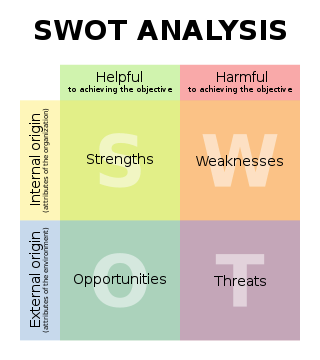
SWOT analysis is a tool for auditing an organization and its environment. It is the first stage of planning and helps marketers to focus on key issues. SWOT respectively represent Strengths, Weaknesses, Opportunities, and Threats. Strengths and weaknesses are internal factors while opportunities and threats are external factors.

For Strengths, an organization's strengths are its resources and capabilities that can be used as a basis for developing a competitive advantage. The examples include patents, strong brand names, good reputation among customers etc.

For Weaknesses, the absence of the above strengths can be viewed as weaknesses. For example, they may lack of patent protection, have a weak brand name, poor reputation among customers, high cost structure etc.

For Opportunities, the external environmental analysis may reveal new opportunities for profit and growth. The examples are arrival of new technologies, loosening of regulations, removal of international trade barriers etc.

For Threats, changes in the external environmental may also be the threats to an organization. The examples are shifts in consumer tastes away from the organization's products, emergence of substitute products, new regulations, increased trade barriers etc.


Conclusion

To conclude, strategic framework helps to analyze both internal, external, macroenvironmental and microenvironmental issue of the organization. Therefore, a right strategic framework is very important for an organization to have a clear vision for its business. It is one of the keys to lead the organizations to success.

Source / Reference:
1)
Suillivan, “Systems planning in the information age,” Sloan Management Review, 1985
2) "PEST: Political, Economic, Social, and Technology Analysis" by The Decision Group 2009
3) “Strategy and Vision Statements"

4) "A knowledge-based SWOT-analysis system as an instrument for strategic planning in small and medium sized enterprises" by G. Houben, K. Lenie, K. Vanhoof 1999
5) “Making the Most of Your Company's Knowledge: A Strategic Framework” by Georg von Krogh, Ikujiro Nonaka, Manfred Aben 2001

2012年2月12日 星期日

W4 - Strategic Alliance Model


Subject:
In Lect 4 - Which alignment strategy in SAM model is the best? and why?
======================================================================
Response:

First, I should briefly define what is SAM. Strategic Alignment Model (SAM) is a framework which is used for aligning IT with business strategy, conceptualizing and directing strategic role or management of IT, leveraging IT on a continuous basis to achieve sustainable competitive advantage. It is widely used as the base of Business and IT alignment theories. This model brings out a key message that the company should ensure the IT strategy is fully aligned with business strategy in order to become a successful company.
There are four dominant alignment perspectives of SAM which are Strategy execution, Technology transformation, Competitive potential and Service level.


To comment on which is the best SAM model, I personally support the argument that there is no best alignment strategy and it depends on different industries and companies. As mentioned by J C Henderson and N Venkartraman, as researchers and observers of strategic management phenomena, we do not believe that there is one universally superior mode to formulate and implement strategy. If there were, it would not be strategic because all firms would adopt it. They basically support the argument. If there were a best model, all firms would make use of it and the model would no longer strategic.
I will now further describe the four dominant alignment perspectives and show their own advantages and successful examples to show all of the four perspectives are good when they are applied to the appropriate nature.

1.      Strategy execution


Business strategy is the driver of both organizational design choices and the design of IT infrastructure. Identifying the specific role of management is the key point to make this succeed. In this perspective, the role of top management is strategy formulator and should articulate the logic and choices pertaining to business strategy while the role of IT manager is strategy implementer and should designs and implements the infrastructure and processes which support the strategy. One more thing is that performance of the IT function is assessed by the financial parameters.


Since strategy execution is the most common and widely understood perspective as it corresponds to the classic, hierarchical view of strategic management, many companies succeed with applying this model.


2.      Technology transformation


Business strategy is the driver of IT strategy and IT infrastructure. This model use appropriate IT strategy to implement the business strategy. The role of top management is technology visionary that best support the business strategy and the role of IT manager is technology architect that designs and implements the IS infrastructure that is consistent with IT vision. This alignment perspective is not constrained by the current organization design. It uses to identify the best possible IT competencies. The other thing is that performance in term of IT market position is assessed by a benchmarking approach.


A successful example is American Express Travel Related Services Co., Inc. It has two technology-based competencies which are providing quick approval of purchases made by charge card and providing copies of receipts to the cardholders. By this, American Express can catch the response time of the leading competitors so as to avoid the cardholders switching to the alternative with faster transacting card.


3.      Competitive potential


IT strategy is the driver of business strategy and organizational infrastructure. This model is to allow adaptation of business strategy via emerging IT capabilities. It seeks to identify the best set of strategic options for business strategy. The role of top management is business visionary that estimates how IT competencies affect the business strategy while the role of IT manager is catalyst that identifies the IT environment so as to assist the business managers to know more about the opportunities and threats of emerging IT. In this perspective, business performance is assessed by business/product leadership including market share, growth and new product introduction.


A successful example of competitive potential is Baxter Healthcare. It enhances Technology scope, greater systemic competencies and governance with IBM through the Spectrum joint venture that will provide software service to the health care marketplace.


4.      Service level


IT strategy is the driver of IT infrastructure and organizational infrastructure. Applying this model is to ensure the effective use of IT. It focus on how to build a world-class IT service organization. The role of top management is prioritizer that allocate the resources within the organization and IT marketplace while the role of IT managers is executive leadership that ensure the internal service business succeed. The performance is assessed by the level of customer satisfaction.


A successful example of service level is PARKnSHOP. It makes use of the RFID technology to make the customers more convenient and have better buying experience. It supports using Octopus card to pay which fasten the billing procedure and it uses MoneyBack card which allow customers to save the cash dollar. By this, PARKnSHOP can maximize the customers’ satisfaction.


To conclude, all of the four SAM models have their own advantages and they can lead the companies to success if the models are adopted in the right nature and well used. There is no best model and it depends on different industries and companies.

Source / Reference:
1)  "Strategic Alignment: Leverage Information Technology for transforming organization" by J C Henderson and N Venkartraman 1993
2) “Using and validating the strategic alignment model” by David Avison, Jill Jones, Philip Powell, David Wilson 2004
3) “The Strategic Alignment Model of Henderson and Venkatraman”
4) Strategic Alignment: Analysis of Perspectives” by Coleman, Preston and Papp, Raymond 2006